Why this exists#
If you own a Queenslander in Paddington, a Federation cottage in West End, or any of the older homes scattered through the inner suburbs, you’ve probably hit the heritage overlay rule. It surprises a lot of homeowners. You ring up to get a quote on a new roof, the roofer takes a look, and the first thing they say is “we need to do a DA”.
I’ve been around the Brisbane roofing world long enough to have seen this conversation a hundred times. The good news: it’s not as bad as it sounds. The bad news: if you skip it, you can end up with a council enforcement notice and a roof that has to be redone at your cost.
Here’s the playbook for getting through a heritage Development Application without losing six months of your life.
Step 1: Find out if you’re actually in an overlay#
Quick answer: Check the Brisbane City Council interactive mapping tool at brisbane.qld.gov.au and search your address. Look at the planning layers for Traditional Building Character Overlay, Heritage Place, or Heritage Overlay. If any apply, you need a DA.
Don’t assume. Don’t guess based on what your neighbour told you. Check the official mapping.
The tool#
The Brisbane City Council interactive mapping tool at brisbane.qld.gov.au. Search your address and look at the planning layers.
What to look for#
- Traditional Building Character Overlay (pre-1911 or pre-1946 in many cases). This is the most common one and applies to whole streets of pre-war housing.
- Heritage Place (individually listed). Less common, but stricter rules.
- Heritage Overlay (precinct-based). Applies to clusters of heritage homes treated as a group.
- Character precincts: additional layers in some suburbs (parts of West End, New Farm) that add specific requirements.
If your property has any of these, the DA rules apply. If it doesn’t, you can skip to a standard Form 1 building approval.
Special case: “non-contributing”#
Sometimes a property is inside a heritage precinct boundary but is itself “non-contributing” (built later, or significantly modified). Non-contributing properties have lighter requirements. The mapping doesn’t always show this clearly. If you suspect your property is non-contributing, ask council to confirm.
Step 2: Understand what council actually requires#
Quick answer: Replace with material, profile, and colour that match what was originally on the roof. Like-for-like terracotta on terracotta, corrugated iron on corrugated iron. Modern profiles (Trimdek) and modern colours are usually rejected.
The fundamental rule for heritage roof replacements in Brisbane is simple in concept and detailed in practice.
The rule#
Replace with material, profile, and colour that matches what was originally on the roof.
What this means in practice#
- Original terracotta tile means new terracotta tile of the same profile (Marseille, Cordoba, etc.)
- Original corrugated iron means new corrugated iron, not Colorbond Trimdek
- Colour should match the original or be a council-approved heritage palette
- Modern profiles (Trimdek, Klip-Lok) are not accepted on heritage roofs
- Modern colours (Surfmist, Monument) may not be accepted on tile roofs that were originally terracotta-coloured
The exception list#
- Rear additions or non-contributing parts of the building
- Where original material is genuinely no longer manufactured (rare)
- Where the original material has changed multiple times since (council may allow the most recent legitimate version)
Step 3: The pre-application meeting#
This is the move that separates the homeowners who get through the DA smoothly from the ones who get refused twice and lose three months.
What it is#
A short meeting (15 to 30 minutes) with a council heritage officer to discuss your proposed work before you submit the formal DA. It’s free.
Why it matters#
The heritage officer tells you what they’ll approve and what they won’t, before you spend money on plans. You get to refine your scope based on actual feedback rather than guessing.
How to book#
Through the council’s pre-application enquiry form online. Allow 1 to 2 weeks for a meeting slot.
What to bring#
- Photos of your current roof from every elevation
- A simple sketch of what you’re proposing (your roofer can do this in 15 minutes)
- Any documentation about the original roof material if you have it
- Specific questions: material, profile, colour, any planned skylights or solar
The meeting is informal but the heritage officer’s verbal feedback is the gold standard for what will get approved.
Step 4: Prepare the DA#
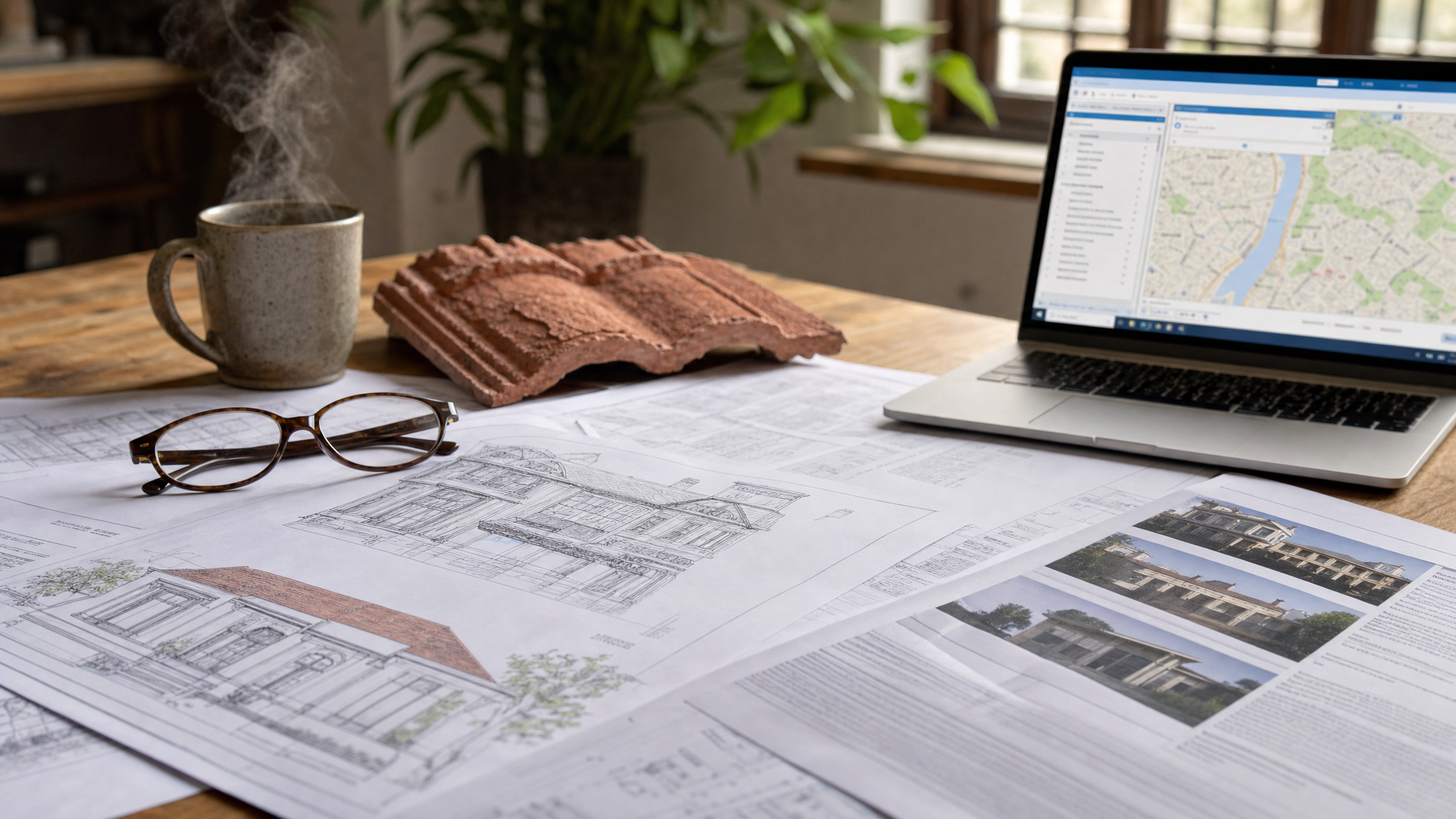
Now you submit the formal application. Most experienced heritage roofers handle this for you as part of the quote.
What goes in the application#
- Site plan showing the property and the roof
- Existing roof condition photos
- Proposed roof material specification (brand, product code, profile, colour)
- Heritage impact statement explaining how the work preserves heritage character
- Council application fee ($800 to $1,500 typically)
Heritage architect’s report#
Some applications need a heritage architect’s report. This is required for more significant changes (material switches, additions, or anything affecting the original form). It adds $500 to $1,000 to the cost.
If you’re doing a like-for-like replacement (same material, same profile, similar colour), you usually don’t need a heritage architect’s report.
Step 5: The 4 to 6 week wait#
Council’s heritage team reviews the application. You don’t have to do anything during this period except respond to any clarification requests they send.
What can happen#
- Approval (most common for like-for-like replacements). You get a written approval and can start the work.
- Approval with conditions. They approve but require specific changes (different brand, different colour, additional details). Read the conditions carefully.
- Refusal. They decline the application with reasons. You can resubmit or appeal.
How to make approval faster#
- Submit a clean, complete application the first time
- Use materials from a recognised heritage palette
- Match exactly what’s on neighbouring properties
- Don’t request material changes if you can avoid them
Step 6: Do the work#
Once approved, the work proceeds like any other re-roof, but with one extra requirement: photographic documentation of the finished result, which council may request for compliance verification.
What to keep#
- Photographs of each elevation before and after
- The approval notice and conditions
- Supplier invoices showing the exact materials used
- A signed completion certificate from the roofer
Council can do random compliance inspections, and being able to produce documentation makes any future enquiry trivial.
Common reasons heritage DAs get refused#
If you’re going to fail, you’ll usually fail on one of these.
Asking to switch from tile to Colorbond#
This is the single most common refusal reason. Unless your property is specifically non-contributing, the council will say no.
Specifying a modern colour for a heritage palette#
Surfmist on a Federation cottage that originally had terracotta-coloured galvanised iron will get knocked back. The colour palette has to fit the era.
Insufficient documentation#
Submitting without proper photographs, without a clear material specification, or without a heritage impact statement. The council will send it back for clarification, which adds 2 to 4 weeks.
Not consulting the heritage officer first#
Submitting “cold” without the pre-application meeting. The DA is much more likely to be refused or returned with conditions, because you don’t know in advance what the officer will accept.
How to pick a heritage-experienced roofer#
The single best thing you can do to make this process easy is to choose a roofer who has done it before in your suburb.
What to ask#
- How many heritage DAs have you submitted in this suburb?
- Will you handle the DA paperwork as part of the quote?
- Do you have a recent example of an approved DA in this street or the next one over?
- What is your typical timeline from quote to start of work, including the DA?
A heritage-experienced roofer typically has the DA paperwork process down to a template and can submit a clean application in 1 to 2 days. A general residential roofer might take weeks and submit something the council bounces back.
The realistic timeline#
Here’s the calendar for a typical heritage re-roof in Paddington, New Farm, West End, or similar.
Week 1 to 2#
Roofer inspection, quote, pre-application meeting with council.
Week 3#
DA submitted to council.
Weeks 4 to 8#
Council assessment period. You wait.
Week 9#
Approval issued (most common).
Weeks 10 to 14#
Materials ordered (heritage materials can have longer lead times), then work begins.
Total: 10 to 14 weeks from initial inspection to a finished roof.#
Plan accordingly. Don’t expect to re-roof a heritage Queenslander on the same timeline as a Colorbond replacement in Chermside.
If you skip the DA#
Don’t. Council does enforcement. The penalties for unauthorised heritage work can include orders to remove the new roof and reinstate the original, at your expense. The fines are also significant.
Even if you somehow get away with it during the work, the next owner’s pre-purchase building inspection will flag the unapproved heritage work, and you’ll be the one paying to fix it before settlement. The DA is the cost of doing business in a heritage suburb.
Ready to get real Brisbane quotes for your roof?
90-second form. Up to 3 vetted local Brisbane roofers contact you within 24 hours. Free, no obligation.
Common questions
How do I know if my Brisbane property is in a heritage overlay?
Check the Brisbane City Council interactive mapping tool at brisbane.qld.gov.au and search your address. The mapping shows heritage overlays, character precincts, and any additional overlays that affect your property. If you see 'Pre-1911 Building Overlay' or 'Traditional Building Character Overlay' on your property, the DA rules apply.
How long does a Brisbane heritage roof DA take?
Typically 4 to 6 weeks for a like-for-like replacement. Material changes (e.g. terracotta to Colorbond) take longer, sometimes 8 to 12 weeks, and have a higher refusal rate. The pre-application meeting with the heritage officer adds another 1 to 2 weeks to the front of the timeline.
How much does a heritage DA cost?
Council application fees are around $800 to $1,500 depending on the scope. Add another $500 to $1,000 if you need a heritage architect's report (sometimes required for non-standard cases). Most experienced heritage roofers include the DA paperwork as part of their quote, so you don't pay separately for the application preparation.
Can I switch from terracotta tile to Colorbond in a heritage suburb?
Generally no within the heritage overlay. Council typically requires material and profile matching. There are narrow exceptions: rear additions, non-contributing buildings, or where the original material is no longer available. Apply for a material change DA only if you have a roofer who has successfully done it in the same street before.
What happens if my heritage DA is refused?
You can resubmit with changes addressing the refusal reasons (usually a different material or profile choice). If you genuinely believe the refusal is unreasonable, you can appeal to the Queensland Planning and Environment Court, but appeals are expensive and slow. In practice, the better strategy is to engage a heritage architect before the first submission.
Related reading
Blog · cost
How much does it cost to repair a roof in Brisbane in 2026?
Brisbane roof repair costs in 2026, from $400 patch repairs to $55K heritage tile re-roofs. Real ranges by job type, suburb factors, and insurance scenarios.
Blog · insurance
How to actually use your insurance for a Brisbane storm-damaged roof
Brisbane storm-damage insurance claims in 2026: what to do in the first 48 hours, how to choose your own roofer, the paperwork that wins claims, and the traps that drag them out.
Suburb · 4064
Paddington
Paddington is one of Brisbane's most heritage-dense suburbs. About 80% of homes sit under the BCC heritage overlay, so most roof replacements have to match original materials. Typical patch repair $500 to $2,400. Heritage-match full re-roof $35K to $55K. About 23% of homes filed claims after the October 2025 hailstorm.
Suburb · 4005
New Farm
New Farm sits on a tight peninsula in the Brisbane River and has the most mixed roof market in the inner city. 62% heritage overlay, 55% pre-1946 housing, but a meaningful slice of modern apartments and unit conversions. Patch repair $600 to $2,800. Heritage-match full re-roof $38K to $58K. Around 19% of homes filed claims after the October 2025 hailstorm.