The line I draw on DIY#
I’ll give you the honest version. There’s a small group of roof jobs that any reasonably competent Brisbane homeowner can do safely from the ground. There’s a larger group of jobs that look easy on YouTube but turn into either a hospital trip or a $5,000 ceiling repair when you get them slightly wrong.
I’ve been around Brisbane roofs for over a decade and I’ve seen the full spectrum, from homeowners who genuinely know what they’re doing to homeowners who watched one video and bought a tube of silicone.
The two questions worth asking#
Before any roof DIY, ask:
- Does it require me to be on the roof itself?
- Does it affect the waterproof seal?
If the answer to either is yes, you’re moving into roofer territory. If both are no, you’re probably fine to DIY.
The four jobs you can safely DIY#
Quick answer: Gutter cleaning (with stable ladder + spotter), visual inspection with binoculars, photographing damage for insurance, and clearing blocked downpipe inlets. Everything else is best left to a roofer.
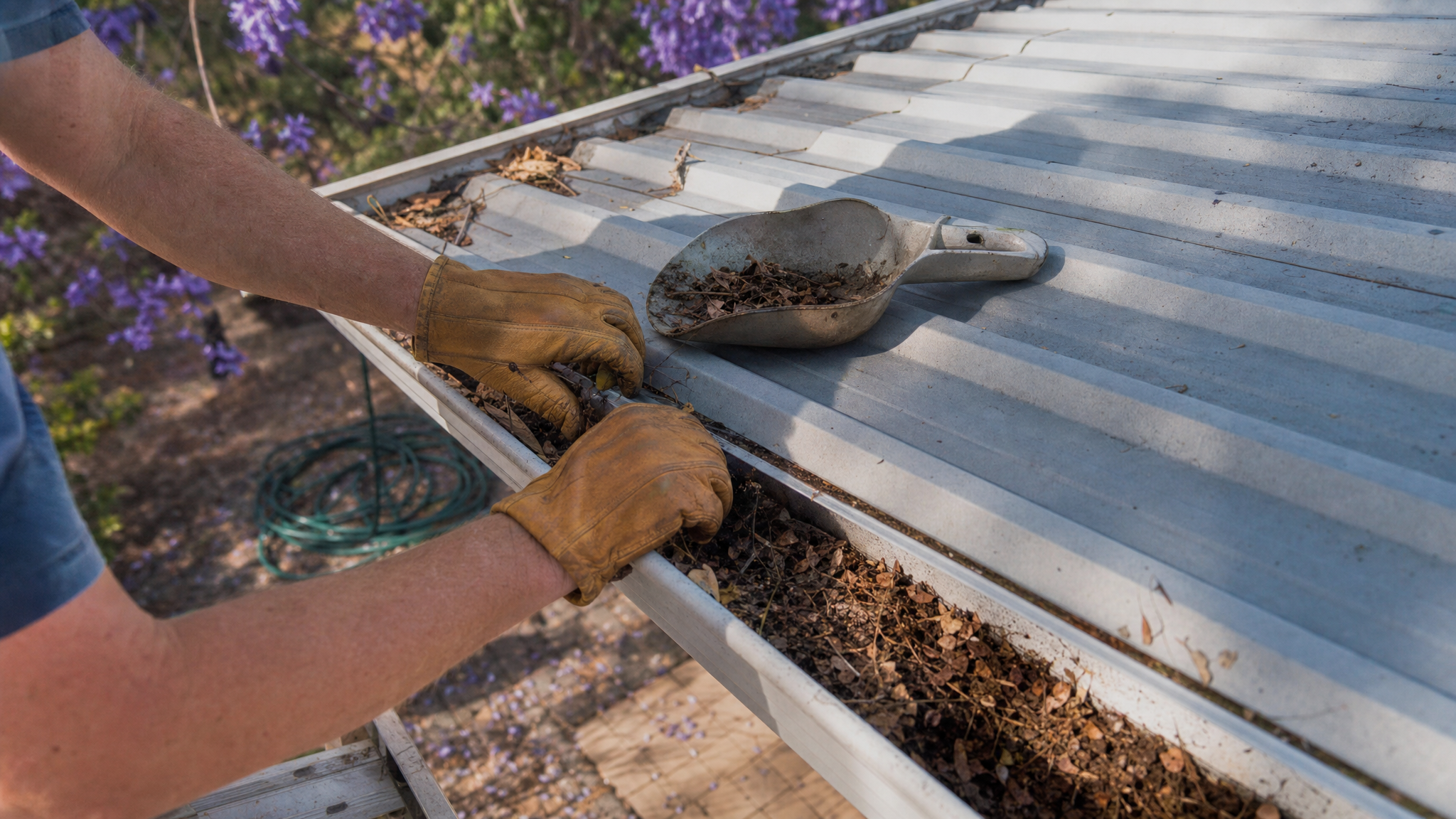
These are the things I’d be happy for a friend to handle without calling me.
1. Gutter cleaning#
The single most common and most useful homeowner roof job. Clears leaf and debris build-up that causes overflow, eaves rot, and ceiling damage.
What you need#
- A stable extension ladder, ideally rated to your weight plus 20%
- Heavy work gloves (gutter edges are surprisingly sharp)
- A bucket on a hook, or a tarp on the ground
- A spotter at the base of the ladder (genuinely, please)
- A garden hose for a final flush
What to do#
Position the ladder beyond the edge of the gutter so you’re not over-reaching. Scoop debris out by hand into the bucket. Work your way along section by section. Finish with a hose flush to confirm water drains to the downpipes.
Skip the DIY if#
The gutter is on a second storey, the roof pitch is steep enough that the ladder can’t sit straight against the eaves, or you don’t have a spotter. Gutter cleaning falls account for a significant share of DIY home injuries in Australia every year.
2. Visual inspection with binoculars#
The pre-storm-season check. Costs nothing, takes 5 minutes, catches most of what would otherwise become an insurance claim.
What to look for#
- Lifted, tilted, or cracked ridge caps
- Rust on flashings around chimneys and skylights
- Cracked, missing, or rotated tiles
- Bowed or dented metal sheets
- Gutter overflow stains down the wall
If you spot something, photograph it from the ground (zoom in with your phone or use the camera on your binoculars). Send the photos to a roofer for a quote. You’ve now done the inspection-gathering work that a roofer would otherwise charge for.
3. Photographing damage for insurance#
After any storm, your first job is to document. Every angle, every elevation, internal and external. Date-stamp the photos.
What to capture#
- Every elevation of the roof from ground level
- Close-up of every visible damaged area (use phone zoom)
- Hail stones with a coin for scale, if you can
- Internal water staining on ceilings
- Damaged contents inside for the contents claim
This documentation is the foundation of an insurance claim. The roofer you eventually pick will add their own photos, but yours are the first record and the date stamp matters.
4. Clearing a blocked downpipe outlet#
The little leaf-catcher cage on top of downpipe inlets fills up easily, especially after autumn. Pulling out a clogged one is genuinely a homeowner job.
How to do it#
From the ladder at gutter level, lift out the leaf-catcher, clear it, hose it down, and reseat it. If you don’t have leaf-catchers fitted, this is a job worth doing once and then leaving alone for two years.
The four things you should never DIY#
Quick answer: Replacing a single tile, resealing or replacing a flashing, anything to do with ridge caps, and climbing onto a wet, steep, or two-storey roof. The savings on a botched DIY are tiny next to the cost of the failure.
These are the jobs that look reasonable on YouTube and are not.
1. Replacing a single tile#
I know, it looks like just lifting one tile and dropping in a new one. Here’s what actually happens: you step on the surrounding tiles, you crack three of them, you drop a tile and it slides off, you pierce the underfelt with the corner of the replacement, you don’t reseat the ridge cap mortar properly, and now you have four broken tiles and a small leak instead of one cracked tile.
Cost of a roofer doing it: $200 to $400. Cost of a botched DIY: $1,500 to $3,000 plus your weekend.
2. Resealing or replacing a flashing#
Flashings look simple. They’re a metal strip with some sealant. They’re actually the single most common place where DIY repairs cause long-term damage. The wrong sealant on a chimney flashing doesn’t bond to lead and fails in 6 months. The wrong angle on a step flashing channels water under the tile instead of over it. The flashing detail around a skylight has to be correct in three dimensions or it leaks.
A roofer charges $200 to $600 for a flashing job. A failed DIY flashing leaks slowly for 12 months and gives you $5K to $12K of internal damage before you notice.
3. Anything to do with ridge caps#
The mortar bedding on a tile ridge cap is a structural seal, not just decorative. Resetting one wrong tilts the cap and creates a wind-catch. The first 90 km/h gust pulls it off and takes neighbouring tiles with it. The resulting cavity flood is the most expensive common Brisbane roofing claim.
4. Climbing onto a wet, steep, or two-storey roof#
Roof falls are the most common cause of serious DIY-related injury in Australia. Even an experienced roofer with proper fall-arrest equipment treats Brisbane roofs with respect. Without that gear, a wet tile under your foot can put you in hospital in less than a second.
The cost of a fall is not measured in dollars. WorkSafe Queensland’s working at heights guidance is worth reading before any DIY roof job.
The insurance question#
This is the part most homeowners don’t think about until it’s too late.
The fine print#
Most home insurance policies have a clause along the lines of “we don’t cover damage caused by faulty workmanship or unlicensed work performed by the insured”.
If you reseal a flashing yourself, it leaks two months later, and your ceiling collapses, the insurer can decline the claim. They can also decline any subsequent damage to the roof that they argue is consequential to your DIY repair.
The exception#
This usually doesn’t apply to gutter cleaning, visual inspection, photographing damage, or other “maintenance” work that doesn’t affect waterproofing.
It does usually apply to any work that involves replacing or sealing any part of the actual roof.
What this means in practice#
For any DIY work that affects the roof itself, do the maths on the savings vs the risk. A $400 saving on a flashing replacement is not worth a potential $15K insurance decline.
The realistic homeowner roof routine#
Here’s what I’d actually recommend a Brisbane homeowner do themselves, on a calendar.
Every 3 to 6 months#
Gutter cleaning. Or annual if you have effective gutter guards.
Every autumn (April to May)#
Visual inspection with binoculars. Photograph anything suspect.
After every severe storm#
Photograph all damage from ground level. Document internal water staining.
Once a year ideally#
Pay a roofer to do a 30 to 45 minute on-roof inspection. They’ll see things you can’t see from the ground, and it’s the best $150 to $300 you’ll spend on the home.
That’s the routine. Do those five things and you’ll skip almost every storm-driven roofing emergency, and you’ll know what’s coming long before it becomes an insurance claim.
Ready to get real Brisbane quotes for your roof?
90-second form. Up to 3 vetted local Brisbane roofers contact you within 24 hours. Free, no obligation.
Common questions
Is it legal to do my own roof work in Brisbane?
Yes, for your own home as the owner-occupier. You don't need a roofing licence to work on your own roof. But you still need a building approval for any structural work, and Queensland workplace safety law applies if you have anyone helping. Insurance is the bigger issue: if your DIY work causes damage or someone gets hurt, your home insurance may decline the claim.
Will my insurance cover damage caused by my DIY roof repair?
Usually not. Most home insurance policies exclude damage caused by faulty workmanship or unlicensed work by the homeowner. If you reseal a flashing and it leaks two months later causing $8K of ceiling damage, the insurer can decline the claim. Always check your PDS before doing any DIY repair that could affect waterproofing.
Can I climb on my own roof to look at damage?
Legally yes. Practically, please don't unless you have proper fall-arrest equipment and someone with you. Roof falls are the most common cause of serious DIY injuries in Australia. Use binoculars from the ground, or pay $150 to $300 for a roofer to inspect and give you photographs.
What roofing jobs are genuinely safe for a homeowner?
Gutter cleaning (with a stable ladder and a spotter), visual inspection with binoculars from ground level, photographing damage for insurance documentation, and clearing debris from downpipe outlets. Everything else, including replacing a single tile, is best left to a roofer.
How much do I save by doing it myself vs hiring a roofer?
Less than you think. A simple patch repair from a roofer is $400 to $800. The DIY materials might be $80, but you also need to factor in your time, ladder hire if you don't own one, and the risk premium. For anything beyond gutter cleaning, the time and risk usually outweigh the cash savings.
Related reading
Blog · seasonal
Brisbane storm season prep: the 5-minute roof check before October
A practical pre-storm-season Brisbane roof check you can do from the ground in 5 minutes, plus the three high-leverage repairs that pay back tenfold when hail hits.
Blog · cost
How much does it cost to repair a roof in Brisbane in 2026?
Brisbane roof repair costs in 2026, from $400 patch repairs to $55K heritage tile re-roofs. Real ranges by job type, suburb factors, and insurance scenarios.
Suburb · 4061
The Gap
The Gap is a leafy middle-ring western suburb that backs onto the Mt Coot-tha bushland reserve. Larger residential blocks, mix of 1970s/80s brick homes and modern infill. Only 3% heritage overlay. Bushfire risk and tree litter are the main local roof factors. Typical patch repair $450 to $2,400. Full re-roof $19K to $34K. Took minor damage in October 2025 hailstorm.
Suburb · 4178
Wynnum
Wynnum is a bayside Brisbane suburb facing Moreton Bay. Mix of original timber bayside cottages, post-war infill, and modern duplexes. Only 8% heritage overlay, but salt air shortens roof lifespans by 5 to 10 years compared to inland suburbs. Typical patch repair $450 to $2,500. Full re-roof $18K to $36K. Wynnum took relatively minor damage in October 2025 hailstorm.