The cheapest insurance you can buy#
If you live in Brisbane, October to March is the part of the year your roof gets tested. Not by everyday rain, but by hail, by 100+ km/h gusts, and by the sustained five-hour downpours that find every weakness in your flashings. The Bureau of Meteorology Brisbane forecast is worth bookmarking from October onwards.
I’ve spent enough time around Brisbane roofs to know what these storms do, and to know what gets called out the morning after. The bad news is most of it is preventable. The good news is the prevention costs almost nothing.
The five-minute opportunity#
The cheapest insurance you can buy against storm damage is 5 minutes with a pair of binoculars in autumn. You’re looking for four specific things, all visible from the ground, all fixable for less than the deductible on your insurance policy.
A pre-storm inspection that catches one lifted ridge cap can save you a $30,000 cavity-rebuild claim. The maths is brutal, and in your favour if you do the check.
The 5-minute ground check#
Quick answer: Walk the perimeter of the house with binoculars and check four things, in order: ridge caps, flashings, valleys/gutters, and the overall roofline for damaged sheets or tiles.
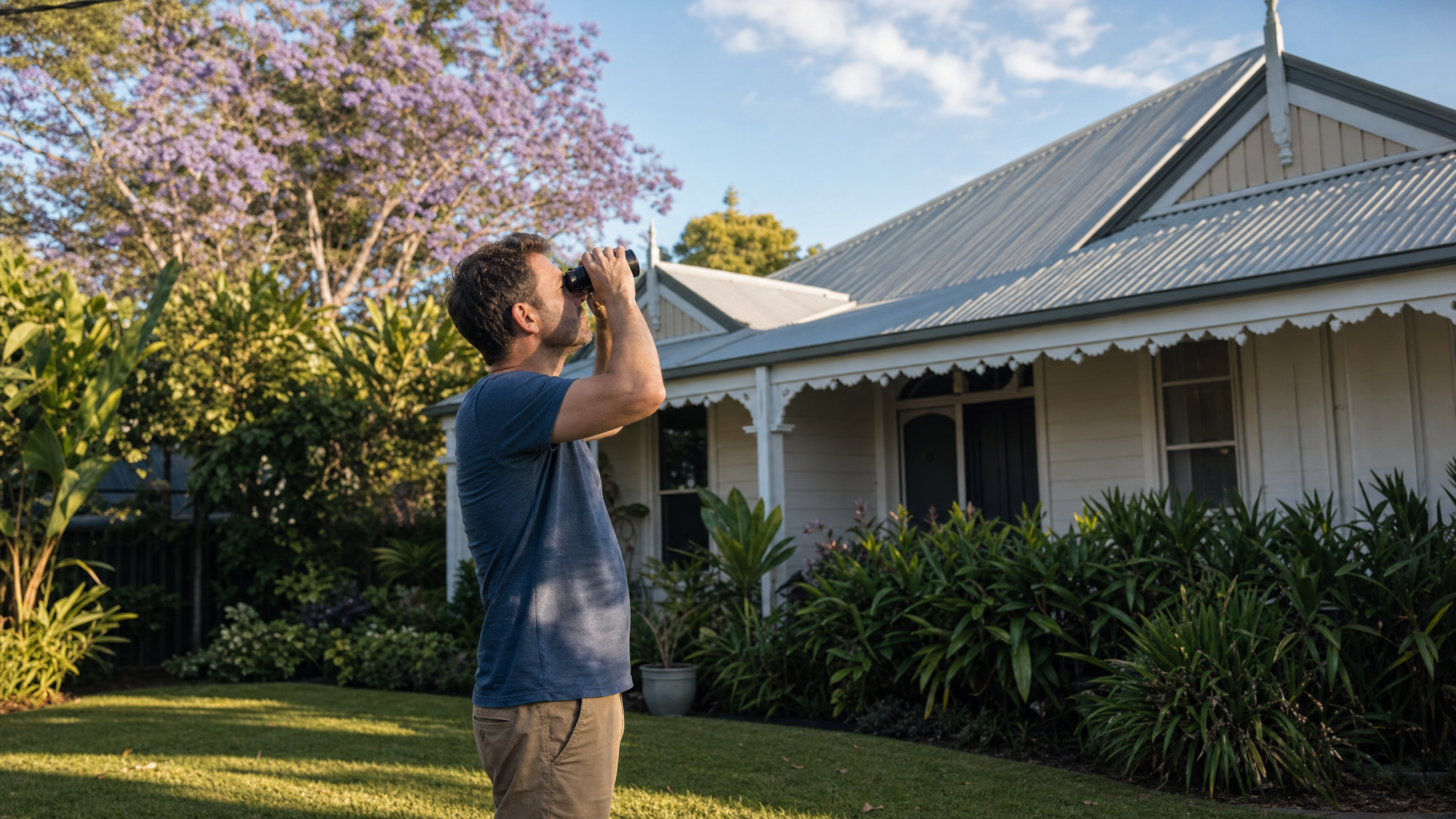
Walk around the entire perimeter of your house with binoculars. Look up at every elevation. You’re checking four things in this order.
1. Ridge caps#
The cap is the strip along the very top of the roof where two sloped sections meet. On tile roofs it’s mortar-bedded clay, and on metal roofs it’s a folded sheet. This is the most exposed part of your roof and almost always the first thing to fail in wind.
What you’re looking for#
- Any cap that’s visibly lifted, tilted, or sitting at a different angle to its neighbours
- Cracked mortar (look for hairline cracks or chunks missing along the base)
- Plant growth or moss (sign that water is pooling there)
- A visible gap between the cap and the ridge underneath
Why it matters#
A loose ridge cap in a 90 km/h wind can fly off entirely and take three or four neighbouring tiles with it. I’ve seen this happen on Paddington homes and it’s a mess. A pre-storm re-bed costs $800 to $2,500, while the insurance claim for the resulting cavity flood costs $15K to $40K.
2. Flashings#
Flashings are the metal strips that seal the joints between your roof and anything sticking out of it: chimneys, skylights, walls, vent pipes, solar panel brackets.
What you’re looking for#
- Any visible rust on the metal strips (orange/brown discolouration)
- Lifted edges or visible gaps where the flashing meets the roof or the wall
- Old silicone sealant cracking or yellowing
- Anywhere a previous “quick fix” is visible (mismatched colour, sloppy work, exposed screws)
Why it matters#
Flashings around chimneys and skylights are the second most common storm-leak source we see. Resealing or replacing one flashing is usually $200 to $600, while the interior ceiling damage from a failed flashing is $2K to $8K.
3. Valleys and gutters#
Valleys are the V-shaped channels where two roof sections meet. Gutters are obvious. Both need to be clear before storm season because water will arrive in volume.
What you’re looking for#
- Visible leaf, twig, or pine-needle build-up in valleys (use binoculars, or get on a ladder safely)
- Gutters that look full of debris or have plants sprouting out of them
- Rust or pinholes along the bottom edge of gutters where they sit against the fascia
- Downpipes that already drip from joints in light rain
Why it matters#
Blocked valleys and gutters cause two failure modes: water overflows back into the eaves and rots the timber, or it pools and finds its way under tiles and sheets. A clean-out is $150 to $400, and most Brisbane roofers will do it as part of a quoted job. Skip it and you’re inviting trouble.
4. Sheets, tiles, and the roof line#
Step back across the road and look at the overall shape of the roofline.
What you’re looking for#
- Any tile that’s visibly cracked, missing, or rotated
- Any sheet of metal that’s bowed, dented, or has visible fastener pops (the silver dots along the ribs)
- A roofline that sways or dips slightly between rafters (suggests sagging structure)
- Rust streaks running down from screws or seams
Why it matters#
Cracked tiles are individual replacements ($30 to $80 per tile plus labour). Sheet damage usually needs section replacement.
The three pre-season fixes worth doing#
Quick answer: Re-bed lifted ridge caps ($800 to $2,500), reseal or replace failing flashings ($200 to $600 each), and clear valleys and gutters ($150 to $400). Total worst-case spend around $3,500; total worst-case prevented loss $30K to $50K.
If your inspection turned up problems, prioritise these three. They’re cheap, they’re high-leverage, and each one prevents a specific common insurance claim that I see come through after every storm season.
Fix 1: Re-bed lifted ridge caps, $800 to $2,500#
What it prevents#
The most common storm-related claim in Brisbane: a flying ridge cap takes other tiles with it and water cascades into the ceiling cavity.
Fix 2: Reseal or replace failing flashings, $200 to $600 per flashing#
What it prevents#
Persistent slow leaks from chimneys, skylights and wall junctions that destroy ceiling plaster and insulation. These leaks often don’t appear in light rain. They appear during sustained heavy storms when the volume overwhelms a weak seal.
Fix 3: Clear valleys and gutters, $150 to $400#
What it prevents#
Eaves rot, ceiling damage from overflow, and the slow-burn failure mode where a blocked valley quietly funnels water under tiles for months until something gives.
The maths#
Total worst-case spend for all three: about $3,500. Total worst-case prevented loss: easily $30K to $50K and three months of insurance back-and-forth.
When to bring in a professional#
The ground inspection above catches 80% of pre-storm issues. The remaining 20% lives up on the roof itself: soft spots on tile underlay, screws backing out of metal sheets, lead flashing detail around chimneys. Those need an experienced eye on the roof, not on the lawn.
Inspection frequency by roof age#
- Over 15 years old, never inspected, get one this winter
- Over 25 years old, get one annually
- After any severe storm, get one immediately, regardless of visible damage
What it costs#
Most Brisbane roofers will do a free inspection on the strength of follow-on work. A 30 to 45 minute inspection in May is the most valuable use of a roofer’s time you’ll ever buy.
A note on hail-resistant materials#
If you’re due for a re-roof anyway#
The Class 4 impact-rated Colorbond profiles are worth the 10 to 15% premium in Brisbane. They handle 4 to 5 cm hail stones without denting, and after one major event you’ve recouped the upgrade.
If your existing roof is fine#
Don’t re-roof just for hail resistance. The economics don’t work. You’re better off banking the money and dealing with hail through insurance if and when it hits.
The autumn calendar#
Here’s the routine I’d run if I owned a Brisbane home. It’s not complicated, but doing it consistently is what keeps you out of the post-storm panic queue.
April to May#
Ground inspection (the one above). Book any repairs.
June to August#
Get repairs done. Winter is quiet season for roofers, so you’ll pay base rates and they have time to do careful work.
September#
Final gutter and valley clean. Check for new growth.
October to March#
Don’t touch it unless something fails. Storm-season rates are high and roofer schedules are full.
That’s the routine. Five minutes in autumn, a few hundred dollars in winter, and you’ll skip the post-storm queue almost every time.
Ready to get real Brisbane quotes for your roof?
90-second form. Up to 3 vetted local Brisbane roofers contact you within 24 hours. Free, no obligation.
Common questions
When does Brisbane storm season actually start?
Officially November to April per the Bureau of Meteorology, but Brisbane hail and severe storms regularly hit in October and even late September. Locally, roofers treat October 1 as the start. The worst hail event in the last decade (October 2025) landed in early October.
How often should I get my Brisbane roof inspected?
Every 2 to 3 years for a roof under 15 years old, every year for a roof over 25 years old, and immediately after any severe storm (hail or 90+ km/h winds). A professional inspection takes 30 to 45 minutes and is usually free if there's a real chance of follow-on work. Just ask.
Are hail-resistant roofing materials worth the upgrade?
In Brisbane, yes if you're already due for a re-roof. Class 4 impact-rated Colorbond and the heavier-gauge profiles handle 4 to 5 cm hail without denting. The cost premium is around 10 to 15% over standard Colorbond, and after one major hail event you've broken even. If your existing roof is fine, don't re-roof just for hail resistance.
What's the single best pre-storm repair I can make?
Resealing or replacing ridge caps. They're the most exposed part of the roof, they fail first in wind events, and a lifted ridge cap lets water cascade into the roof cavity during heavy rain. A ridge-cap re-bed across a typical Brisbane home is $800 to $2,500 and prevents the most common storm-related insurance claim.
Related reading
Blog · insurance
How to actually use your insurance for a Brisbane storm-damaged roof
Brisbane storm-damage insurance claims in 2026: what to do in the first 48 hours, how to choose your own roofer, the paperwork that wins claims, and the traps that drag them out.
Blog · diy
What roof problems can a Brisbane homeowner safely DIY (and what to never touch)
A practical Brisbane guide to roof DIY: the four jobs you can safely do from the ground, the four jobs only a roofer should touch, and the insurance implications.
Suburb · 4061
The Gap
The Gap is a leafy middle-ring western suburb that backs onto the Mt Coot-tha bushland reserve. Larger residential blocks, mix of 1970s/80s brick homes and modern infill. Only 3% heritage overlay. Bushfire risk and tree litter are the main local roof factors. Typical patch repair $450 to $2,400. Full re-roof $19K to $34K. Took minor damage in October 2025 hailstorm.
Suburb · 4178
Wynnum
Wynnum is a bayside Brisbane suburb facing Moreton Bay. Mix of original timber bayside cottages, post-war infill, and modern duplexes. Only 8% heritage overlay, but salt air shortens roof lifespans by 5 to 10 years compared to inland suburbs. Typical patch repair $450 to $2,500. Full re-roof $18K to $36K. Wynnum took relatively minor damage in October 2025 hailstorm.